Wildflowers
Best Native Wildflowers for Clay Soil in the UK
Clay soil has a reputation problem. Dig a border in February and you lift a lump you could bowl with; come August the same ground is cracked and hard as a biscuit. It drains slowly, warms late, and grows grass with alarming enthusiasm. None of that makes a meadow impossible. It just narrows the guest list.
The wildflowers that succeed on heavy clay tend to be the ones that tolerate winter wet and summer baking. Choose those, and a clay meadow can be every bit as lively as a chalk downland — just with a different cast.
What clay actually gives you
Clay particles are tiny and hold on to water and nutrients. That means fertility, which sounds like good news and mostly isn't. Wildflowers flower best on lean ground where grasses can't outcompete them. On clay, the grasses, docks, thistles and nettles will win unless you actively tip the balance.
So the work of a clay meadow is less about feeding and more about thinning. Cutting and removing the growth each year is the single most effective thing you can do. Clay also has a narrow window when it's pleasant to work: too wet and you smear the structure into a pan, too dry and you need a pickaxe. Handle it in early autumn or mid-spring, when it crumbles rather than smears.
Native wildflowers that cope with clay
These are reliable on heavy ground across most of the UK. Plant them as plugs in spring or early autumn, or raise them from seed in modules first — direct sowing into clay is patchy at best.
- Common knapweed (Centaurea nigra) — tough, deep-rooted and long-flowering; a magnet for bees and butterflies.
- Ox-eye daisy (Leucanthemum vulgare) — short-lived but self-seeds freely into gaps.
- Meadow buttercup (Ranunculus acris) — thrives in damp, heavy ground, though it can spread.
- Selfheal (Prunella vulgaris) — low and creeping, filling the spaces between tussocks and flowering into September.
- Yarrow (Achillea millefolium) — flat flowerheads, drought-proof once established.
- Field scabious (Knautia arvensis) — a taproot that pushes through clay that bakes hard in summer.
- Meadow cranesbill (Geranium pratense) — blue-purple flowers in June and July, unfussy about soil.
- Cowslip (Primula veris) — spring nectar on clay that stays cool and moist.
- Betony (Stachys officinalis) — long-lived and steady, good for a meadow you don't want to replant.
- Tufted vetch (Vicia cracca) — climbs through grasses; bumblebees work it hard.
- Red clover (Trifolium pratense) — only worth including where fertility is already low.
- Ribwort plantain (Plantago lanceolata) — modest but valuable; its seed heads hold through winter.
For the wettest clay
If a corner holds water into spring, stop fighting it and plant for it: purple loosestrife, meadowsweet, ragged robin and great burnet all cope with ground that stays damp well into April. They also give you colour in July, when drier parts of the meadow are between flushes.
Don't forget the grasses
A meadow needs grasses, just not too many. Meadow foxtail and Yorkshire fog are naturals on heavy soil, while crested dog's-tail and red fescue add finer texture. Aim for a mix where flowers make up roughly half the sward — more than that on poor clay, less if your ground is rich.
Yellow rattle: useful, but not a guarantee
Yellow rattle parasitises grasses and opens up space for flowers, which is exactly what a clay meadow needs. It is worth trying, with caveats. On heavy clay, germination can be patchy and establishment slow. Sow fresh seed in September or October, pressed into bare soil, and keep the grass short through autumn so seedlings get light. Give it two or three years, overseeding each autumn, before deciding it hasn't worked.
Preparing and planting without wrecking the soil
- Check what you're dealing with. Squeeze a damp handful into a ball; if it holds firmly and takes a shine when rubbed, you have plenty of clay.
- Strip the competition. Cut existing grass as short as you can, rake out thatch, and remove every clipping. Fertility is the enemy here.
- Don't dig deep. Loosen only the top few centimetres, or plant straight into slits. Deep cultivation on clay creates a smeared pan below.
- Skip the sand. Mixing sand through heavy clay tends to produce something closer to brick than loam. Instead, spread well-rotted compost as a surface mulch and let worms do the incorporating.
- Improve the planting hole, not the field. A little grit and compost around each plug helps it through the first winter without changing the soil you've chosen.
- Plant in the right window. Mid-spring or early autumn, when the ground is workable. Never tread wet clay — you'll compact it for years.
Space plugs roughly five to seven per square metre, grouped in loose clusters rather than evenly dotted. A meadow looks natural when plants clump, and clumps survive better than singletons.
Cutting and care through the year
On clay, the annual cut matters more than anything else you do. Leave the meadow to flower and set seed through summer, then cut in late August or early September to about 5–7cm. Rake off everything you cut — leaving it to rot returns nutrients and strengthens the grasses you're trying to suppress. A second cut in late October keeps things tidy and helps yellow rattle the following autumn.
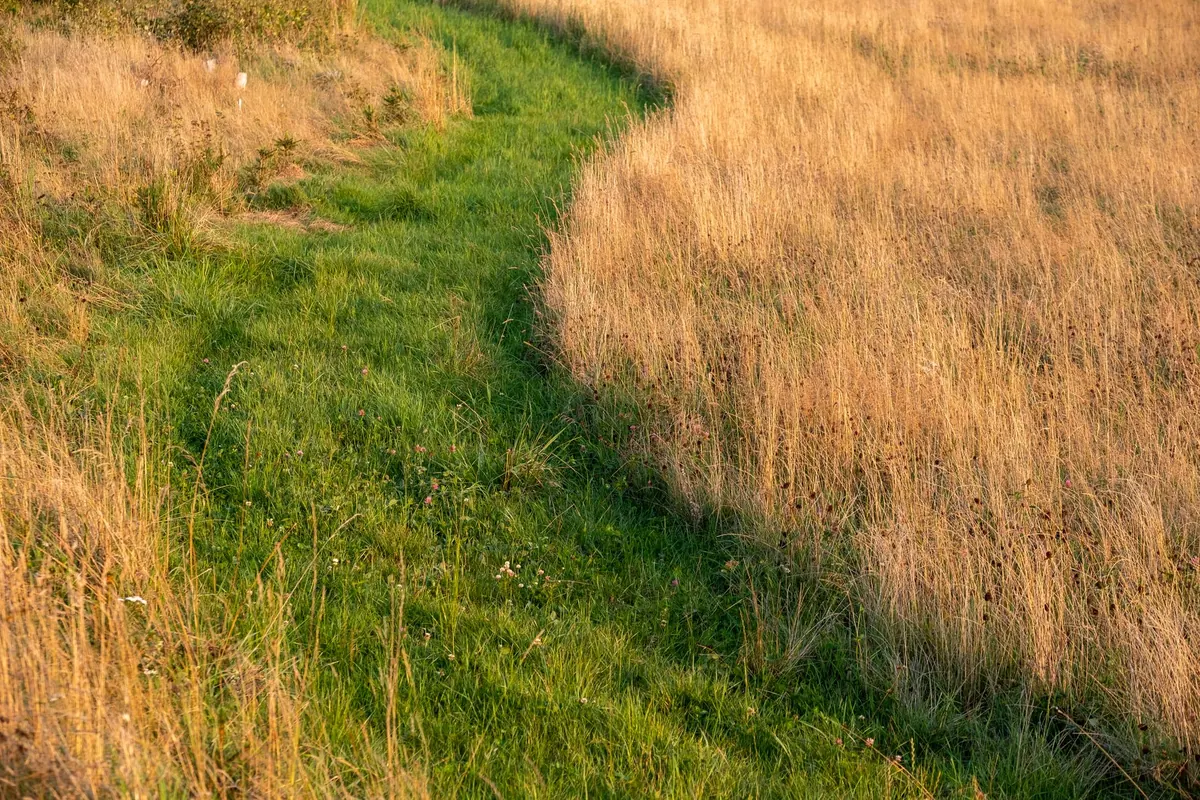
Keep a mown path or edge around the meadow; it frames the planting and gives you somewhere to walk when the ground is soft. Avoid walking across the meadow in wet winter weather. In the first year, pull or fork out docks, creeping thistle and nettle before they seed — on clay they will otherwise take hold fast.
Putting plants together
Front to back, a clay meadow reads well as: selfheal and cowslip at the edges, meadow cranesbill and betony through the middle, then knapweed, field scabious and tufted vetch rising into the grasses. Add ox-eye daisy in generous drifts for early colour, and let meadowsweet mark the damp patches. Keep it to a dozen species. A short, well-chosen list looks more convincing than a scattergun mix, and the plants establish better for it.
Start small, and start in autumn
If your clay is new to this, take on a patch of perhaps three metres by three rather than the whole lawn. Strip it, plant plugs in September, water them through their first dry spell, and cut and clear next summer. You'll learn how your particular soil behaves — how long it stays wet, how quickly it bakes — without gambling the entire garden on it.
Once knapweed and cranesbill are settled, the meadow starts to look after itself. From then on it's a matter of one cut a year, cuttings removed, and a little patience with the thistles.
Photo: Ann Barnes / Pexels
Related Articles