Planting
Choosing Grasses for a British Meadow: A Practical Guide
A meadow is mostly grass. That is worth stating plainly, because most people arrive at meadow-making thinking about ox-eye daisies, knapweed and buttercups. The flowers get the attention; the grasses do the work — closing the canopy, holding the soil, feeding the insects that shelter in tussocks, and setting the tone of the whole planting. Choose the right grasses and the wildflowers have somewhere to live. Choose badly and you will spend three summers fighting a coarse green mass that smothers everything else.
Read your soil before you open a seed catalogue
Grasses sort themselves by soil far more strictly than most flowers do. Three things matter: how wet the ground stays, how fertile it is, and whether it leans acid or alkaline.
You can learn a good deal with a spade and a pair of eyes. Dig a hole a spade deep and look at the colour and structure. Squeeze a handful of soil: if it moulds into a shiny ball that holds its shape, you are on clay; if it crumbles and refuses to bind, you are on sand or chalk.
Then look at what already grows there. Creeping buttercup, ryegrass and docks point to fertile, improved ground — the hardest starting point, because most meadow grasses are built for lean conditions. Sheep's fescue, thyme and salad burnet suggest thin, dry, low-fertility soil. Rushes and sedges mean the ground lies wet for much of the year. Sow for what you actually have, not for what you wish you had.
The backbone: fine-leaved grasses for a traditional hay meadow
These are the species that make up old neutral grassland, and they belong in almost any British meadow mix on ordinary soil. They are slow to establish — some look like nothing for a full season — but they live for years and tolerate both mowing and grazing.
- Common bent (Agrostis capillaris) — fine, tough and quietly ubiquitous. It knits the sward together, copes with close cutting and never bullies its neighbours.
- Crested dog's-tail (Cynosurus cristatus) — the classic hay meadow grass, with a neat, comb-like seed head. Slow, long-lived and one of the best partners for wildflowers.
- Red fescue (Festuca rubra) — narrow blue-green blades, drought tolerant, happy on poorer ground. Excellent on banks and thin soils.
- Sweet vernal grass (Anthoxanthum odoratum) — the one that gives freshly cut hay its vanilla-hay scent. Flowers early, stays small, and signals genuinely low fertility.
Aim for a mix dominated by grasses of this type. If your seed mix is full of agricultural species, the flowers will be gone within two seasons.
Grasses for clay, damp and flood-prone ground
Heavy, wet ground needs species that can sit through a wet winter without rotting off, then grow away quickly in spring.
Meadow foxtail (Alopecurus pratensis) is the earliest grass to flower and thrives on damp neutral clay; its pollen is valuable for early insects, though it can look untidy by midsummer. Smooth meadow-grass (Poa pratensis) creeps steadily and holds heavy soil together. Tufted hair grass (Deschampsia cespitosa) forms handsome evergreen tussocks that give structure and winter cover in a wet meadow, but it is vigorous — keep it to a small proportion of the mix, or plant it as isolated clumps. On genuinely acid, boggy ground, purple moor-grass (Molinia caerulea) is the natural choice. Timothy (Phleum pratense) suits damp clay if you are cutting a real hay crop, but it is bulky and too dominant for a small garden meadow.
Grasses for thin, dry and chalky soils
On limestone, chalk or sandy ground, the fine fescues come into their own. Sheep's fescue (Festuca ovina) is drought-proof, low-growing and content in almost no soil at all. Upright brome (Bromus erectus) belongs on chalk downland and gives a soft, wafty midsummer look. Yellow oat-grass (Trisetum flavescens) and quaking grass (Briza media) add delicate seed heads rather than bulk. Cocksfoot (Dactylis glomerata) will survive a drought better than almost anything, but it is coarse and tussocky — use it at a low rate on a dry bank where little else will grow.
Nurse grasses and the ones that take over
Some grasses establish fast and cover the ground while slower species settle. Useful in small amounts, they become a problem in quantity. Treat these with caution:
- Perennial ryegrass — quick, aggressive and greedy. It has no place in a wildflower meadow, however cheap the mix.
- Yorkshire fog — soft, grey-green and endlessly adaptable. Fine as a minor component; a thug in fertile ground.
- Tall oat grass — vigorous on rich verges, and quick to swamp smaller plants.
- Cocksfoot — reliable but coarse; never let it exceed a few per cent of the mix.
Most good wildflower mixes run at roughly 80 per cent grass to 20 per cent flowers by weight, with the grass fraction made up of fine, non-aggressive species.
Sowing: ratios, timing and the first year
- Reduce fertility first. If the ground has been fed or heavily grazed, mow and remove the cuttings for a season or two before sowing.
- Clear perennial weeds properly — this is the step people skip, and the one that decides the outcome.
- Prepare a fine, firm seedbed. Tread it, rake it, tread it again; seed should sit on a surface that has stopped moving.
- Mix seed with dry sand or sieved soil so you can see where it lands, then broadcast in two directions at right angles.
- Sow in late August or September where you can — the soil is warm, rain is likely and roots establish before winter. March to April works, but expect more annual weeds and possible drought.
- In the first year, mow to about 6–8cm every six to eight weeks and take the clippings away. Never scalp below 5cm.
Wildflower meadow seed is sown far more thinly than lawn seed — often a fifth of the rate or less. Follow the rate on the packet rather than guessing; too dense is a common and expensive mistake.
Keeping the balance: cutting, grazing and yellow rattle
Once established, the grass needs managing rather than feeding. Cut the main meadow in late July or August, after the flowers have set seed, and remove the hay — every cut you take away is fertility leaving the site. A second cut or a short spell of grazing in September or October keeps the sward open and stops the coarse grasses gaining ground.
If the grass still overwhelms the flowers, yellow rattle (Rhinanthus minor) is the traditional answer. It is a wildflower, not a grass, but it parasitises grass roots and thins the sward naturally. Sow it in autumn and let it see a cold winter; it needs that chill to germinate.
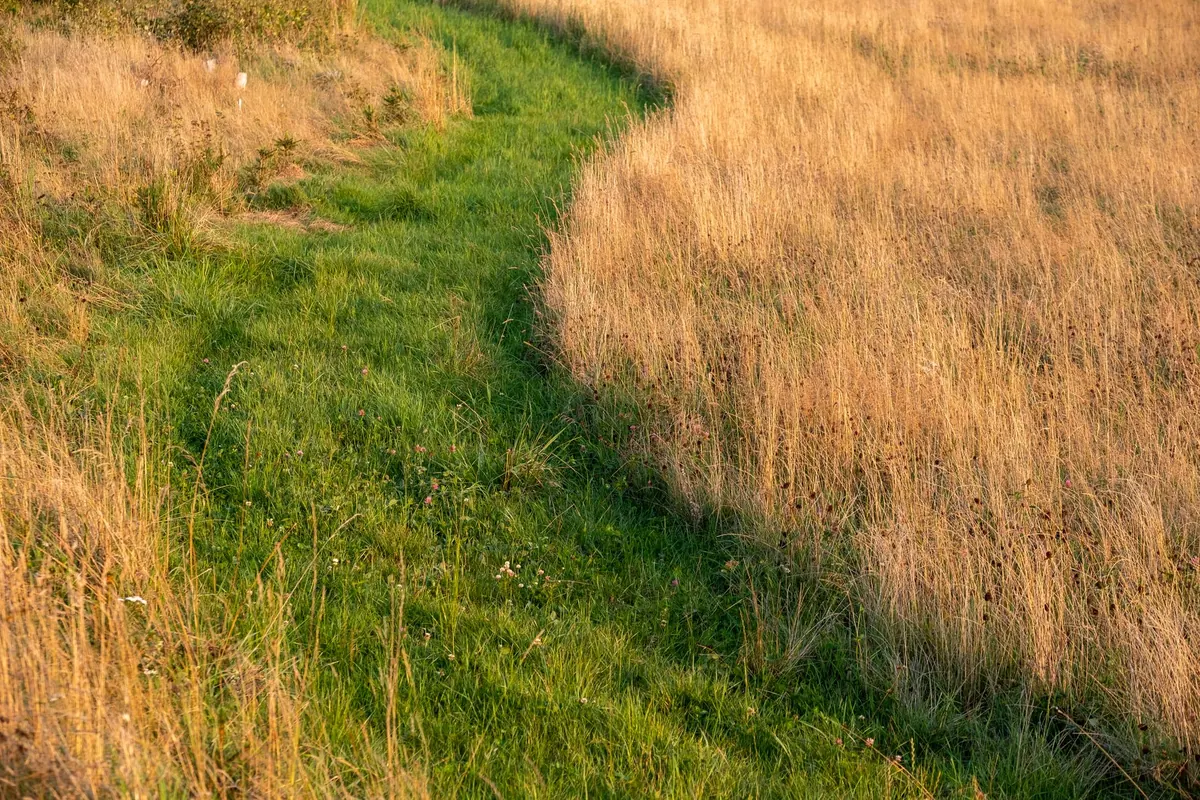
Expect the first year to look thin and the second to look better. By the third summer, a well-matched sward on the right soil should be holding its own with almost no input beyond a cut and a rake. If you are managing a small garden meadow, mow winding paths through it — the contrast between short and long grass is what makes the whole thing read as deliberate rather than neglected. Keep a notebook of what appears and what disappears; the meadow will tell you more about your soil than any test.
Photo: Tonmoy Bhakta / Pexels
Related Articles