Wildlife
How to Attract Bees, Butterflies and Other Pollinators to Your Meadow
A meadow is not a flowerbed with taller plants in it. It is a small ecosystem: a food supply, a nursery and a winter shelter rolled into one patch of ground. Get that idea straight and the planting decisions almost make themselves. The aim is something in flower from March to October, and enough undisturbed, scruffy corners for insects to nest, breed and sit out the cold months.
Start with sunlight and poor soil
Pollinators need warmth. A meadow in shade will flower, but it will flower late, thinly and with far fewer insects visiting. So pick the sunniest ground you have — six hours of direct sun a day is a reasonable benchmark — and accept that it may be your worst lawn rather than your best border.
The other essential is low fertility. Rich soil grows lush grass that flops over and smothers wildflowers. If you have been feeding an area, mulching it, or letting clippings lie, it will take two or three seasons of cutting and clearing to bring it back. Never add compost or fertiliser to a meadow patch. If you are converting a lawn, the cheapest route is to mow it hard all season and remove every clipping; the sward weakens and gaps open up for sowing.
Choose plants for a long season, not a lovely fortnight
Most disappointing meadows fail on one point: everything flowers in June and then nothing happens. Build your plant list around succession, and think about flower shape as well as colour, because a long-tongued garden bumblebee and a short-tongued solitary bee are looking for quite different things.
- Early (March to May): cowslip, cuckooflower, red dead-nettle, dandelion, lungwort. These feed queen bumblebees emerging from hibernation, when little else is open.
- Early summer (June to July): ox-eye daisy, common knapweed, bird's-foot trefoil, red and white clover, meadow buttercup, selfheal. Bird's-foot trefoil is a favourite of common blue butterflies as well as bees.
- High summer (July to August): field scabious, betony, marjoram, viper's bugloss, purple loosestrife on damp ground, and teasel, whose seedheads later feed finches.
- Autumn: devil's-bit scabious, greater knapweed, asters and late-flowering hawkweeds, plus ivy left to flower on a boundary wall.
Flat, open flowers such as daisies and yarrow suit small beetles, hoverflies and short-tongued bees. Tube-shaped flowers such as foxglove and dead-nettle suit bumblebees. Umbellifers — cow parsley, wild carrot, fennel — bring in the tiny parasitic wasps and hoverflies that quietly keep aphids in check. Avoid double-flowered cultivars; many have lost their nectar and stamens entirely.
Grasses are habitat, not filler
A meadow with no grasses is just a crowded border. Tussocky species such as cock's-foot and tufted hair-grass give caterpillars of meadow brown, ringlet and speckled wood something to eat, and their dense bases stay humid and warm at ground level — exactly what frogs, beetles and overwintering larvae need. Leave seedheads standing into winter rather than tidying them away in October.
Beyond the flowers, a good pollinator patch usually includes:
- bare, undisturbed soil in a sunny spot for mining bees and solitary wasps
- hollow plant stems and old fence posts left in place for stem-nesting bees
- a log pile or dead hedge at the edge, ideally south-facing
- a shallow dish of water with pebbles for landing
- a native hedge or shrub nearby for shelter and nesting birds
Sowing and establishing a patch
You can sow seed, plant plugs, or take green hay from a local meadow cut in late summer. Seed is cheapest; plugs establish fastest on stubborn ground. Whichever you choose, preparation is everything.
- Clear the ground properly. Strip turf or cut the existing growth as short as possible and rake off the debris.
- Weaken the grass further by cutting it repeatedly for a few weeks before sowing, removing all cuttings.
- Use a seed mix suited to your soil type — a sandy mix on free-draining ground, a clay or damp mix elsewhere — and check the species list rather than the picture on the packet.
- Mix the seed with dry sand or fine compost so you can see where it lands, then broadcast it in two passes, at right angles.
- Sow in autumn where possible; soil is warm and moisture is reliable. Spring sowing works but needs watering.
- Consider yellow rattle. This native annual draws nutrients from grass roots and opens the sward up, which is often the single change that lets wildflowers survive.
- Tread or roll the seed in lightly so it makes contact with the soil, then leave it alone.
Expect little in the first year. Most meadow perennials put energy into roots before they flower, so a sparse, grassy patch is normal. Year two brings the first real show; year three is when it starts to look like a meadow.
Managing the meadow through the year
The cut is where most meadows are won or lost. Traditional hay meadows were cut once, late, and grazed afterwards — and that rhythm suits wildlife beautifully.
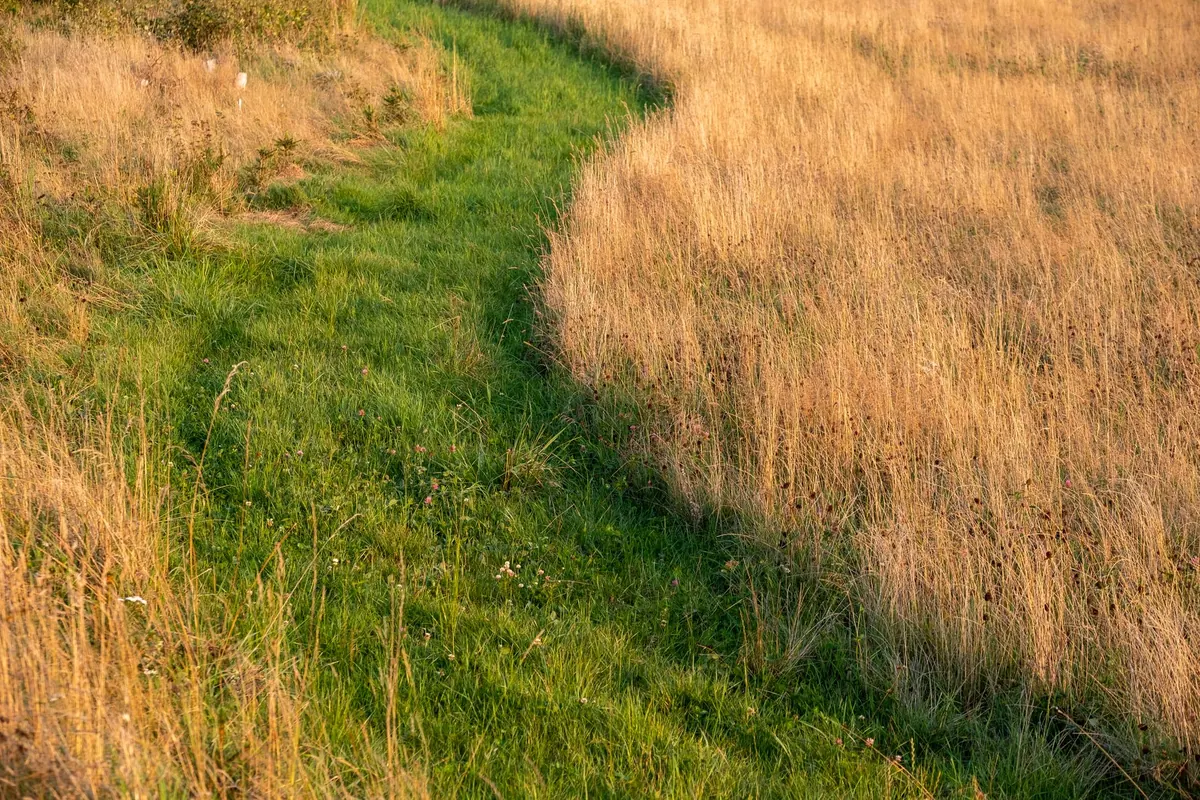
Leave the main cut until late July or August, once most flowers have set seed. Cut to around 5–10cm with a strimmer, scythe or mower on its highest setting, then — this is the part people skip — rake up and remove every clipping. Leaving them to rot feeds the grass and starves the flowers. If you cannot face doing the whole patch at once, cut it in strips a fortnight apart so there is always somewhere for insects to retreat to.
If growth gets away from you in spring, a light cut in April keeps things manageable, but raise the blades and take the cuttings off. From autumn to late winter, leave the meadow standing; that is when seedheads, hollow stems and tussocks do their quiet work.
A simple first-year plan
Start with a patch you can manage — a few square metres is plenty. Spend the first season weakening the grass and removing cuttings. Sow or plant in autumn, water only if the weather turns dry, and resist the urge to tidy anything from October onwards. Then cut once, late, and clear the hay.
In spring, walk the patch with a notebook and see what has arrived on its own. Meadows reward patience more than effort, and the bees, butterflies and hoverflies will find you long before the flowers look perfect.
Photo: bernswaelz / Pixabay
Related Articles